Building a Large Language Model (LLM) prototype is only the first step toward developing a successful AI-powered application. The real challenge is transforming experimental AI solutions into reliable, scalable, secure, and production-ready systems. This is where Forward Deployed Engineering (FDE) plays an important role.
An advanced FDE engineering approach focuses on bridging the gap between AI experimentation and real-world business implementation. It combines software engineering, Generative AI, LLMs, Retrieval-Augmented Generation (RAG), AI Agents, APIs, cloud infrastructure, and deployment strategies to build solutions that solve actual business problems.
Through practical FDE training, learners can understand how to develop LLM-based applications, integrate them with enterprise systems, optimize their performance, and deploy them into production environments.
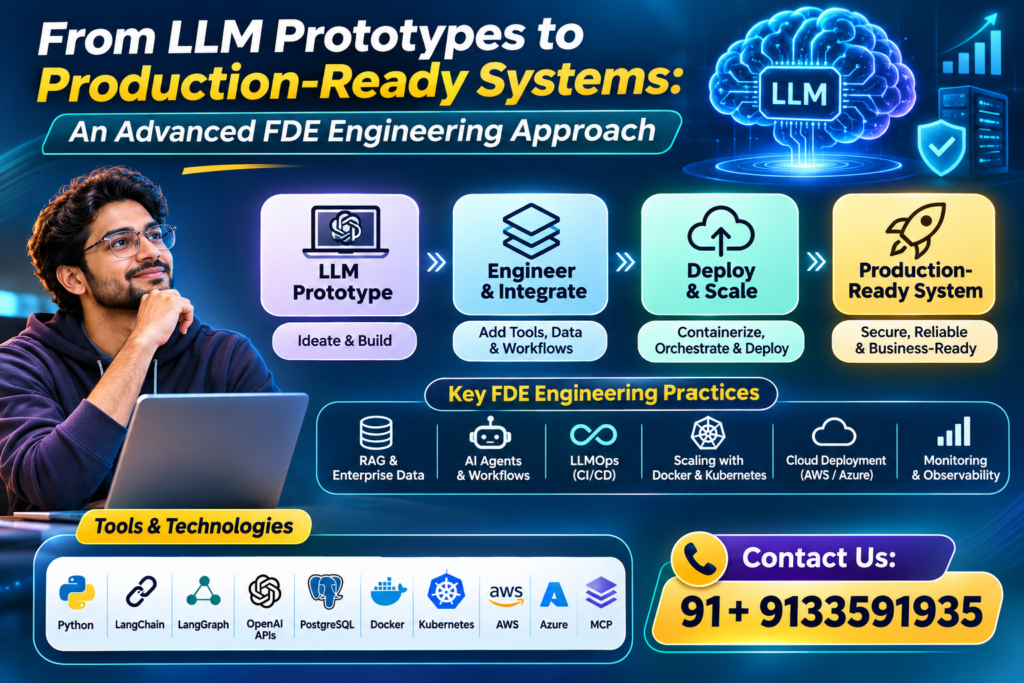
1. Understanding the Journey from LLM Prototypes to Production
An LLM prototype demonstrates how an AI solution works in a controlled environment. However, production applications require much more than basic prompt engineering.
A production-ready LLM system must support:
-
Real-world user requirements and business workflows.
-
Reliable and accurate AI-generated responses.
-
Secure data handling and access control.
-
Scalable infrastructure and deployment.
-
API integrations with existing applications.
-
Continuous monitoring and performance optimization.
-
Error handling and system reliability.
FDE engineers help transform experimental AI applications into practical solutions that businesses can use every day.
2. Building Advanced LLM Applications
Developing advanced LLM applications requires knowledge of different frameworks, technologies, and engineering practices.
Important areas include:
-
LLM Integration: Working with models such as GPT and other open-source LLMs.
-
Prompt Engineering: Designing effective prompts to improve response quality.
-
RAG Architecture: Connecting LLMs with external knowledge sources for context-aware responses.
-
Vector Databases: Storing and retrieving relevant information using semantic search.
-
AI Agents: Developing intelligent agents that can perform tasks and automate workflows.
-
MCP Integration: Connecting AI models with external tools, services, and data sources.
These technologies help engineers develop intelligent applications that go beyond simple chatbot functionality.
3. Converting AI Prototypes into Production Systems
Moving an LLM application into production requires a structured engineering approach.
Key development stages include:
-
Requirement Analysis: Understand business challenges and identify suitable AI solutions.
-
Prototype Development: Build an initial LLM application to validate the concept.
-
Backend Development: Develop application logic using Python and backend frameworks.
-
API Integration: Connect AI applications with databases and enterprise services.
-
Testing and Validation: Evaluate accuracy, performance, reliability, and security.
-
Cloud Deployment: Deploy applications using cloud platforms and containerization.
-
Monitoring and Optimization: Continuously monitor application performance and improve results.
Following these stages helps transform experimental projects into scalable business applications.
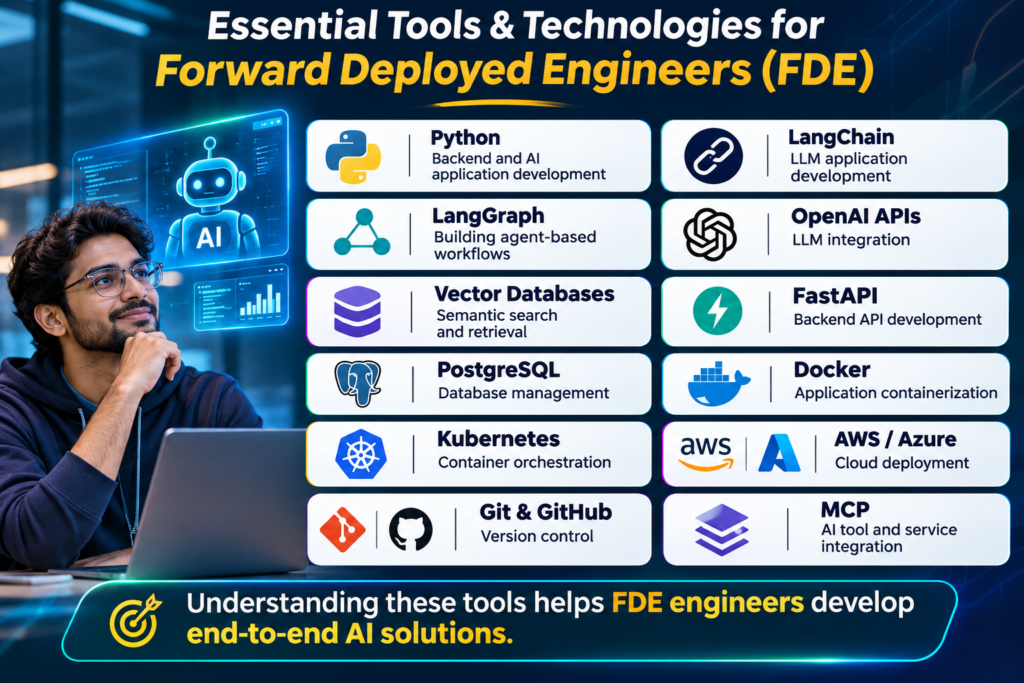
4. Essential Tools and Technologies for Advanced FDE Engineers
Modern Forward Deployed Engineers work with multiple technologies to develop, integrate, and deploy AI-powered applications.
5. Challenges in Deploying LLM Applications
Deploying AI applications in real-world environments comes with several challenges.
Hallucinations and Accuracy: LLMs may generate incorrect information. RAG, validation, and evaluation techniques can help improve reliability.
Scalability: Applications must handle increasing users and requests without performance issues.
Latency and Cost: Optimizing model selection, token usage, caching, and inference can reduce response times and operational expenses.
Security and Privacy: Sensitive business information must be protected through authentication, authorization, and secure data handling.
Integration Complexity: AI applications often need to communicate with multiple databases, APIs, and enterprise platforms.
An experienced FDE engineer understands how to identify and address these challenges during implementation.
6. Why Learn Advanced FDE Engineering?
Forward Deployed Engineering combines AI development with practical software engineering and business problem-solving.
Learning advanced FDE engineering helps you:
-
Develop real-world LLM-powered applications.
-
Build RAG-based enterprise solutions.
-
Create intelligent AI Agents and automation workflows.
-
Integrate AI applications with APIs and databases.
-
Deploy applications using Docker and cloud platforms.
-
Understand production-level testing and monitoring.
-
Work on practical enterprise-oriented projects.
For aspiring AI engineers and software developers, these skills provide a strong foundation for working on modern AI implementation projects.
7. Learn Advanced FDE Engineering with Practical Training
If you want to move beyond basic LLM development and build real-world AI applications, learning Forward Deployed Engineering can be a valuable step.
Our FDE Course in Hyderabad focuses on practical learning, industry-relevant technologies, and real-time project development.
The training covers:
-
Python and Backend Development
-
REST APIs and Integrations
-
Generative AI and LLMs
-
Retrieval-Augmented Generation (RAG)
-
AI Agents and MCP
-
Vector Databases
-
Cloud Deployment
-
Docker and CI/CD
-
Real-Time Industry Projects
-
Interview Preparation and Placement Assistance
Whether you are a fresher, working professional, or software developer, this learning path helps you understand how modern AI solutions are developed and deployed.
Frequently Asked Questions (FAQs)
1. What is the difference between an LLM prototype and a production-ready LLM application?
An LLM prototype demonstrates basic functionality, while a production-ready application focuses on scalability, security, reliability, monitoring, and performance.
2. What technologies are required to build production-ready LLM applications?
Python, LangChain, LangGraph, RAG, Vector Databases, FastAPI, Docker, cloud platforms, and LLM APIs are commonly used.
3. What is the role of an FDE engineer in LLM deployment?
An FDE engineer develops, integrates, deploys, and optimizes AI applications to solve real-world business problems.
4. Is RAG important for production-ready AI applications?
Yes. RAG helps LLMs retrieve relevant information from external knowledge sources and generate more context-aware responses.
5. Can beginners learn Advanced FDE Engineering?
Yes. Beginners can start with Python and backend fundamentals before progressing to LLMs, RAG, AI Agents, APIs, and cloud deployment.
Start Your FDE Engineering Journey!
Learn how to transform LLM prototypes into production-ready AI applications with practical Forward Deployed Engineer training.
Join our FDE Course in Hyderabad and build real-world AI engineering skills.
Name: W3 Forward Deployed Engineer Course
Address: 409, 4, th flloor, Adityan Enclave, Flat No, Annapurna Block, Ameerpet, Hyderabad, Telangana 500016
Contact Us: 91+ 9133591935