1. Introduction
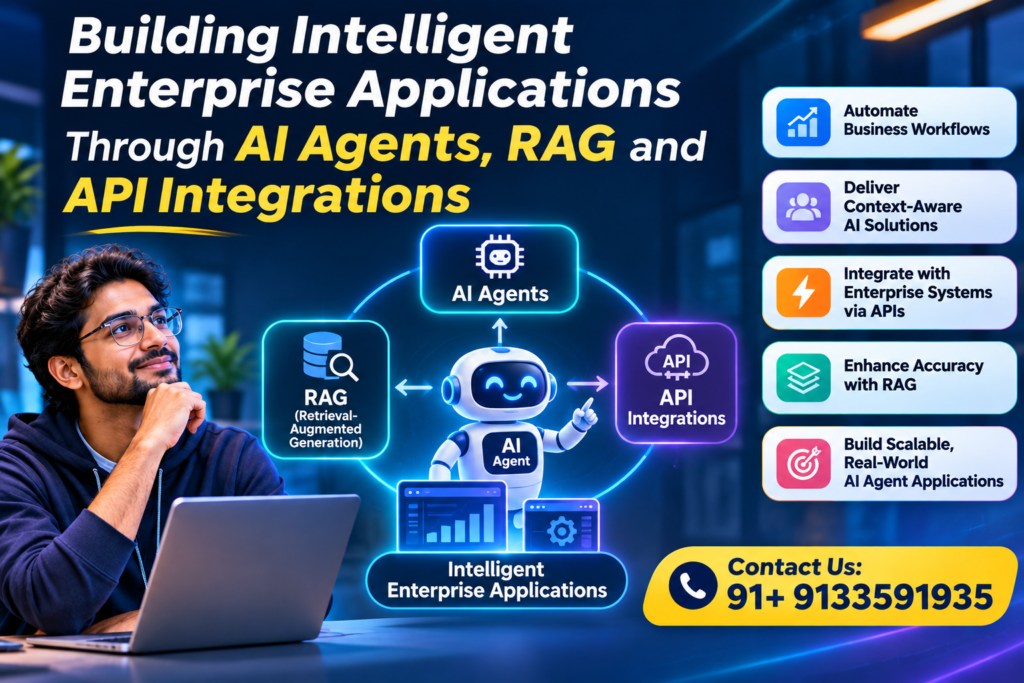
Intelligent enterprise applications are transforming how businesses operate, automate workflows, manage data, and interact with customers. With advancements in Artificial Intelligence, AI Agents, Retrieval-Augmented Generation (RAG), and API integrations, organizations can develop smarter applications that improve productivity and streamline business operations.
Modern enterprises need more than traditional software applications. They require intelligent systems that can understand user queries, retrieve relevant information, make decisions, execute tasks, and connect with multiple business platforms.
By combining AI Agents, RAG architecture, and API integrations, developers can build enterprise applications that deliver accurate responses, automate repetitive tasks, and provide real-time business insights.
2. What Are Intelligent Enterprise Applications?
Intelligent enterprise applications are software solutions that use AI technologies, automation, and integrated data systems to support business processes.
These applications can understand natural language, analyze large datasets, retrieve relevant information, and perform actions based on user requirements.
Key capabilities include:
-
AI-powered customer support and virtual assistants.
-
Automated business workflows and operations.
-
Intelligent document processing and data extraction.
-
Real-time information retrieval and analysis.
-
Integration with CRM, ERP, and enterprise platforms.
-
Automated reporting and decision support.
3. Role of AI Agents in Enterprise Applications
AI Agents are intelligent systems designed to understand instructions, make decisions, and perform tasks with minimal human intervention.
Unlike traditional chatbots that primarily respond to predefined questions, AI Agents can interact with tools, access external systems, execute workflows, and complete multi-step tasks.
Key applications of AI Agents include:
-
Workflow Automation: Automate repetitive business processes and operational tasks.
-
Customer Support: Handle customer queries and provide contextual responses.
-
Task Execution: Perform actions such as creating tickets, updating records, and sending notifications.
-
Business Intelligence: Analyze information and generate useful insights.
-
System Integration: Connect enterprise applications with external tools and services.
Frameworks such as LangChain, LangGraph, and CrewAI help developers build and manage AI-powered agent workflows.
4. Understanding RAG in Enterprise Applications
Retrieval-Augmented Generation (RAG) is an AI architecture that combines information retrieval with Large Language Models (LLMs).
It enables AI applications to retrieve relevant information from external knowledge sources before generating responses.
Instead of relying only on information learned during model training, RAG applications can use company documents, databases, knowledge bases, and internal business information.
How RAG Works:
-
Data Collection: Gather information from PDFs, documents, databases, and enterprise knowledge bases.
-
Data Processing: Clean, organize, and divide information into smaller text chunks.
-
Embedding Generation: Convert text into vector representations using embedding models.
-
Vector Storage: Store embeddings in vector databases such as Pinecone, FAISS, or ChromaDB.
-
Information Retrieval: Retrieve relevant information based on user queries.
-
Response Generation: Pass the retrieved context to an LLM to generate relevant responses.
Benefits of RAG:
-
Provides context-aware responses.
-
Reduces unsupported AI-generated answers.
-
Uses company-specific information.
-
Supports updated knowledge sources.
-
Improves enterprise knowledge management.
5. Importance of API Integrations
API integrations allow different software applications, services, and platforms to communicate with each other.
In intelligent enterprise applications, APIs connect AI Agents and RAG systems with existing business infrastructure.
For example, an AI-powered customer support agent can retrieve customer information from a CRM, check order status through an API, and automatically create a support ticket.
Common API integration use cases:
-
Connecting AI applications with CRM and ERP systems.
-
Retrieving real-time business information.
-
Automating customer onboarding processes.
-
Integrating payment and notification services.
-
Connecting internal databases with AI Agents.
-
Automating ticket creation and customer support.
Developers commonly use REST APIs, FastAPI, Python, webhooks, and authentication mechanisms to build secure and scalable integrations.
6. Technologies Used to Build Intelligent Enterprise Applications
Building intelligent enterprise applications requires knowledge of AI frameworks, backend development, databases, cloud technologies, and integration tools.
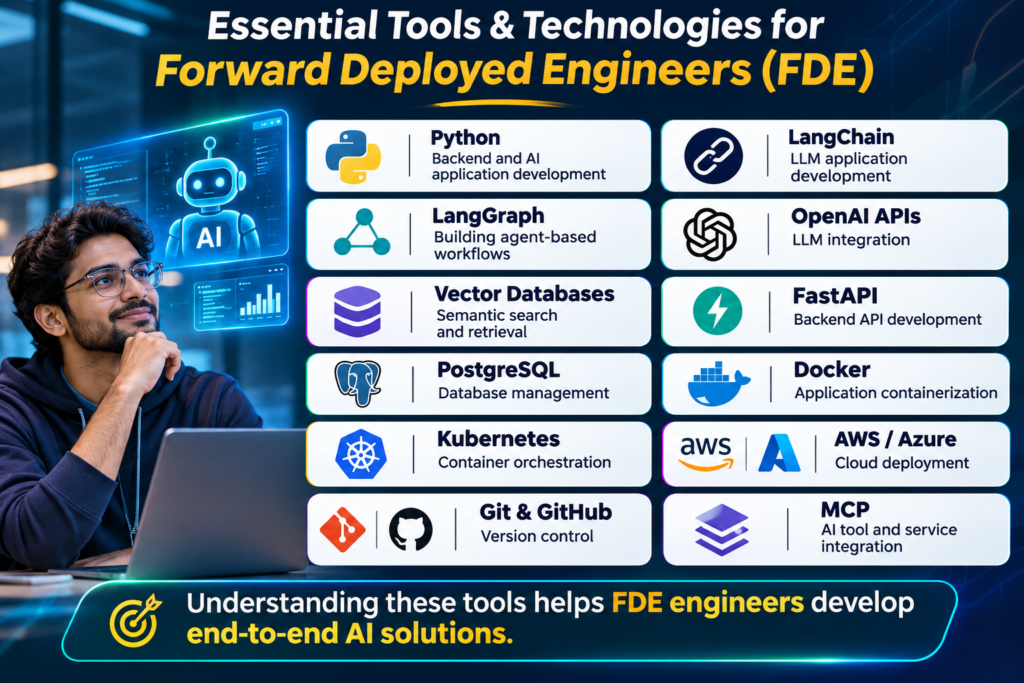
Understanding these technologies helps developers create practical, scalable, and production-ready AI applications.
7. Real-World Applications of AI Agents, RAG and API Integrations
Organizations across different industries are adopting intelligent enterprise applications to improve efficiency and automate business operations.
Some important applications include:
-
Healthcare: AI-powered medical information assistants and document retrieval systems.
-
Banking: Intelligent customer support and financial document processing.
-
E-commerce: Product recommendation systems and automated order support.
-
Education: AI-powered learning assistants and knowledge management platforms.
-
IT Operations: Automated incident management and technical support agents.
-
Human Resources: Resume screening, employee assistance, and recruitment workflow automation.
These solutions demonstrate how AI Agents, RAG, and API integrations can transform traditional business applications into intelligent systems.
8. Benefits of Building Intelligent Enterprise Applications
Combining AI Agents, RAG, and API integrations offers several advantages for modern organizations.
-
Improved Productivity: Automate repetitive tasks and reduce manual work.
-
Better Decision-Making: Generate insights using relevant business information.
-
Faster Operations: Connect multiple enterprise systems through APIs.
-
Enhanced Customer Experience: Deliver faster and more contextual responses.
-
Scalable Architecture: Build applications that support growing business requirements.
-
Reduced Operational Effort: Streamline workflows using intelligent automation.
9. Future of Intelligent Enterprise Applications
The future of enterprise software is moving towards agentic AI, autonomous workflows, and connected business ecosystems.
AI Agents will increasingly collaborate with other agents, access enterprise tools, retrieve information through RAG systems, and execute complex business operations.
Technologies such as Model Context Protocol (MCP), multi-agent systems, LLMs, and cloud-native architectures will further expand the capabilities of intelligent enterprise applications.
Developers with practical knowledge of Python, Gen AI, RAG, AI Agents, APIs, and cloud technologies will be well-positioned to contribute to this evolving technology landscape.
10. Conclusion
Building intelligent enterprise applications through AI Agents, RAG, and API integrations is becoming an important part of modern software development. These technologies enable businesses to automate workflows, connect enterprise systems, retrieve accurate information, and develop smarter applications.
Learning FDE Course and Python, LLMs, RAG, AI Agents, API development, and cloud technologies can help aspiring developers build practical AI-powered enterprise solutions and prepare for emerging opportunities in AI engineering.
Frequently Asked Questions (FAQs)
1. What are intelligent enterprise applications?
Intelligent enterprise applications use AI, automation, and integrated systems to improve business processes and decision-making.
2. What is the role of AI Agents in enterprise applications?
AI Agents automate tasks, interact with external tools, execute workflows, and assist users with business operations.
3. What is RAG in Generative AI?
RAG combines information retrieval and LLMs to generate responses using relevant information from external knowledge sources.
4. Why are API integrations important for AI applications?
API integrations connect AI systems with databases, CRM, ERP, and other enterprise platforms to exchange information and execute tasks.
5. Which technologies are required to build AI-powered enterprise applications?
Python, LangChain, LangGraph, LLMs, RAG, vector databases, FastAPI, REST APIs, and cloud platforms are commonly used.
Name: W3 Forward Deployed Engineer Course
Address: 409, 4, th flloor, Adityan Enclave, Flat No, Annapurna Block, Ameerpet, Hyderabad, Telangana 500016
Contact Us: 91+ 9133591935