A student once showed me his notebook. He’d copied every tool mentioned in some YouTube playlist. Forty-two names. Kafka, Kubernetes, Airflow, three different vector databases, two clouds. He looked exhausted. “Sir, how many months for all this?”
I told him to cross out about thirty of them.
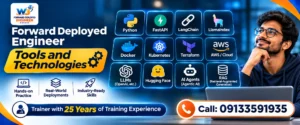
That’s the thing nobody says about Forward Deployed Engineer Tools. You don’t need everything. You need a small set you know really well, plus the confidence to pick up new ones when a client throws something unfamiliar at you. And trust me, they will.
Why the list looks so long
Every client is different. One runs on AWS. The next one has Azure, a twenty-year-old SQL Server and a sales team living inside Excel. Your job as an FDE is to walk into that mess and make something useful.
The title itself came from Palantir. If you’re curious how it started, the Forward Deployed Engineers in Ameerpet has the history. These days, though, most FDE work revolves around AI. So the toolkit has grown.
But the core? Still pretty small.
Start with Python and SQL. Seriously.
I know, it sounds boring. Everyone wants to jump to LLMs. But in my experience, students who rush past Python and SQL end up stuck in week six, debugging things they don’t understand.
Python runs nearly every AI library you’ll touch. SQL is how you talk to client databases, and you’ll write queries almost every day on the job. Get joins and group by into your fingers. Window functions too, once you’re comfortable.
JavaScript can wait. You might need it someday for a quick dashboard. Not now.
Then learn to handle ugly data
Clients never hand over clean data. Never. You’ll get CSVs with three date formats, blank columns and duplicate customers spelled slightly differently.
Pandas is what you’ll use to fix that. Spend real time on it. Learn PostgreSQL properly as well. Once one database makes sense, MySQL and SQL Server don’t feel scary anymore.
APIs: the glue for everything
Here’s a question you’ll hear constantly: “Can your AI pull data from our CRM?”
The answer almost always involves an API. So learn to build one with FastAPI. Test it with Postman. Understand JSON, auth tokens and webhooks. It’s not glamorous work, but it’s honestly half the job.
Cloud, Docker and Git
Your project can’t live on your laptop forever. Pick one cloud and get decent at it. AWS shows up most in job posts. Azure is everywhere in big enterprise clients. Either is fine to start.
Docker comes next. It packages your app so it runs the same on any server. And Git with GitHub isn’t optional at all. Every team uses it. Plus your GitHub profile quietly works as your resume.
Now the fun part: AI tools
Okay. This is where most of today’s FDE demand comes from.
You’ll start with LLM APIs from OpenAI, Anthropic’s Claude or Google’s Gemini. Learn how prompts work, what tokens cost, and why responses sometimes go off track. Clients will ask you about cost in the very first meeting. Have an answer ready.
After that, frameworks like LangChain or LlamaIndex. Some engineers love them. Others find them heavy and just write plain Python. I’d say learn one framework, but make sure you understand what it’s doing under the hood.
In our AI FDE Course in Hyderabad, this section takes the longest. Interviewers dig deep here.
RAG and vector databases
If you read FDE job posts this year, you’ll notice RAG keeps popping up. It lets an AI answer from a company’s own documents, like HR policies, product manuals or contracts.
For this you need embeddings and somewhere to store them. ChromaDB is easy for practice. Pinecone is common in production. And if the client already uses PostgreSQL, pgvector lets you keep everything in one place. Learn one deeply. The rest feel similar.
Automation tools clients actually love
Most business owners don’t want “an AI app.” They want their existing tools to get smarter.
That’s where n8n or Zapier help. You connect forms, WhatsApp, email, CRMs and sheets, then drop AI in the middle. n8n can be self-hosted for free, which a lot of Indian clients prefer. Combine it with Python and you can automate almost any boring process.
The tools people forget
Logging. Monitoring. Debugging.
Nobody makes reels about these. But once your system goes live, something will break at the worst moment. Good logs tell you what happened. For LLM apps, LangSmith lets you trace why the model gave a weird answer.
A client can live with a bug. What makes them nervous is when you can’t explain it.
Then there’s the everyday stuff. Jira for tasks. Notion or Confluence for docs. Slack or Teams for chats. A screen recorder for quick demo videos. These won’t get you hired. But not knowing them makes your first month painful.
So, what order should you follow?
Here’s roughly how we sequence it with students:
| Learn first | Learn next | Pick up on the job |
|---|---|---|
| Python | FastAPI | TypeScript |
| SQL | Docker | Kubernetes |
| Pandas | AWS or Azure | A second cloud |
| Git and GitHub | LangChain or LlamaIndex | LangSmith |
| One LLM API | ChromaDB or pgvector | Pinecone |
| n8n basics | Webhooks and auth | Client-specific tools |
Students in our Forward Deployed Engineer Classes in Ameerpet follow something close to this. It’s not rigid. Some people move faster on AI if they already code.
The mistake I keep seeing
Collecting tools like stickers.
Someone does a two-hour tutorial on ten tools, lists all ten on their resume, and then freezes when the interviewer asks one real question. It happens a lot. Too often, actually.
I’d much rather see six Forward Deployed Engineer Tools used properly in two or three full projects. Deployed. Working. Explained clearly. That stands out way more than a long list.
If you’re new and don’t want to waste months figuring out the order, an FDE Course in Hyderabad can give you that structure.
A few quick answers
Do I need Palantir Foundry?
Only if you’re aiming for Palantir or their partner firms. Most companies use general tools instead.
AWS or Azure?
AWS if you’re unsure. Azure if you’re targeting big enterprise clients. Switching later isn’t hard.
Is LangChain a must?
Not really. It’s common in job posts, so it helps. Understanding the concepts matters more.
Can I learn all this free?
Mostly, yes. Free tiers exist for nearly everything here. The tricky part is putting them together into real projects.
Where this takes you
Get comfortable with these Forward Deployed Engineer Tools and a lot of doors open. AI startups, product firms and consulting companies in Hyderabad are all hiring. Our guide on Forward Deployed Engineer Career Opportunities in Hyderabad lists the roles and what they expect.
Want to see any of this in action? Drop by our Ameerpet centre and chat with a trainer. You’ll find us on Google Maps.
W3 Forward Deployed Engineer Course
Address: 409, 4, th flloor, Adityan Enclave,
Flat No, Annapurna Block, Ameerpet,
Hyderabad, Telangana 500016
Phone Number: 9133591935